
Las Vegas is a common stop for deportation flights. A top provider is now cutting ICE ties.


Avelo Airlines will end its contract with the airline broker hired by Immigration and Customs Enforcement (ICE) and stop its deportation flights by Jan. 27, spokesperson Courtney Goff told The Nevada Independent Tuesday.
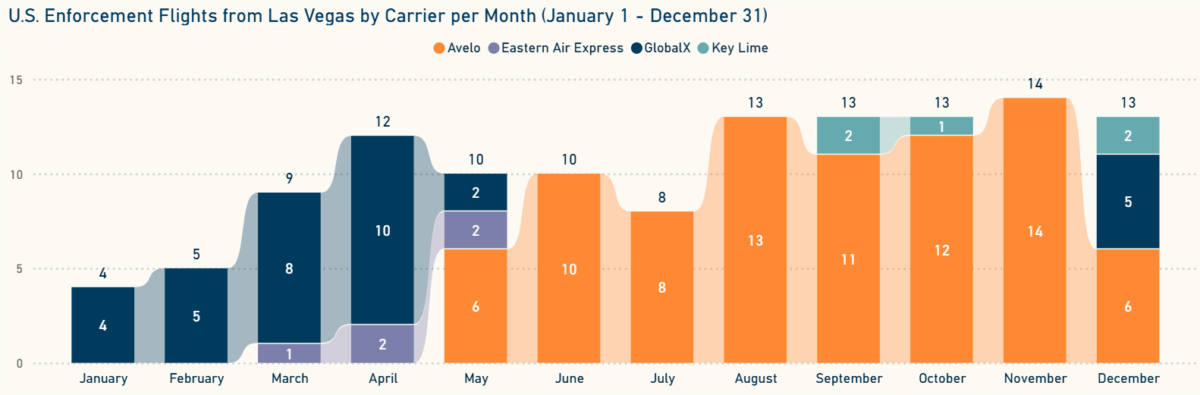
The budget, Houston-based airline operated the majority of the 124 ICE-chartered flights that stopped at Las Vegas' Harry Reid International Airport in 2025, according to new data shared exclusively with The Indy by the immigrant- and refugee-focused nonprofit Human Rights First. That's more than double the 60 ICE-chartered flights that passed through Las Vegas in 2024.
Of last year's flights, 74, or nearly 3 of 5, were operated by Avelo, which ceased commercial operations in Las Vegas in August.
Goff said Avelo's contract "provided short-term benefits but ultimately did not deliver enough consistent and predictable revenue to overcome its operational complexity and costs."
It is unclear why deportation flights stop in Nevada and if the planes pick up detainees held in detention centers in the state. ICE discloses little information about the flights' passengers or paths, multiple immigration experts told The Indy.
ICE representatives did not respond to requests for comment from The Indy.
Federal immigration authorities use the flights to transfer detainees between detention centers and major deportation facilities and to deport detainees.
Some detainees are placed on multiple domestic flights before being sent to deportation facilities in a process Human Rights First refers to as the domestic "shuffle."
The Obama and Biden administrations also shuffled detainees around the country, but the pace of such flights has increased dramatically under the Trump administration. The ICE Flight Monitor counted more than 7,300 domestic shuffle flights between Jan. 20 and Nov. 30, 2025, a 114 percent increase compared with the number of shuffle flights during the same period in 2024.
The Los Angeles Times reported in September 2025 that detainees were being transferred at much higher rates under the second Trump administration than under Biden, with twice as many detainees being transferred at least four times compared with in 2024.
How deportation flights work
Deportation flights are notoriously difficult to track and the process has grown even more opaque under the second Trump administration, said Savi Arvey, director of research and analysis at Human Rights First.
The nonprofit tracks the flights through its ICE Flight Monitor using publicly available aviation data, according to its website.
Arvey told The Indy that while the Biden administration also kept data on deportation flights secret, it was generally more forthcoming when detainees were removed to foreign countries.
ICE contracts its air operations through the company CSI Aviation, which in turn subcontracts operations to 10 airline carriers. Although federal immigration agents are usually onboard, flights are primarily staffed by the airlines' civilian crews.
Last month, The Washington Post reported that the Department of Homeland Security had purchased a fleet of Boeing 737 planes to operate deportation flights directly, a departure from the agency's usually exclusive reliance on chartered planes. It is unclear when the DHS-owned planes will begin operating flights.
At least some of the airlines with deportation contracts, including Avelo, have removed their logos from aircraft used to transport detainees, leaving only tail numbers as identification. The airlines have also utilized a federal aviation law that allows them to block certain planes from appearing on flight tracking websites.
That leaves only a handful of resources available to track ICE flights. Human Rights First's flight monitor relies on a "very complex process that took us a long time to learn," said Arvey.
Beyond the lack of public transparency over flight patterns, immigration experts told The Indy that detainees often have no idea where they are going and whether they are being sent to another domestic facility or being permanently deported.
"This can make people terrified," said Michael Kagan, a UNLV professor who directs the university's immigration law clinic. "ICE moves people with no warning. Lawyers aren't told. Family isn't told. … They'll even sometimes reverse the move and bring people back to the first detention center with no explanation."
Kagan also said ICE fails to regularly update its detainee locator.
Relocations make it harder for detainees to secure adequate legal representation, Kagan said. Sometimes detainees are transferred out of state before lawyers can complete their intake requirements, he said, and some states have residency requirements for legal filings that make it impossible for detainees to secure consistent representation.
"It's definitely not what you would do if you wanted fair procedures and to make sure the law is applied correctly," he said.
Lucas Guttentag, a professor at Stanford Law School who tracks federal immigration policy, told The Indy he believes the increase in domestic transfers is part of "the public spectacle and private terror of the Trump administration's actions."
The purpose of domestic shuffles, he argued, "is to frighten people about enforcement actions."
Last year, both ProPublica and The American Prospect reported on allegations by multiple flight attendants of inadequate security and safety measures on ICE-chartered flights, including federal agents forcing detainees to remain handcuffed while in the air and failing to check detainees' luggage before takeoff.
Airports also have little information about or control over deportation flights.
Harry Reid International Airport spokesperson Monika Bertaki told The Indy that they do not receive advance notice of ICE-chartered flights and do not receive information on passengers onboard. "Armed federal agents that are on airport property" do trigger additional security measures, she said.
The deportation flights are organized by two aeronautical service companies that have contracts with Harry Reid, Bertaki said. Neither of those companies responded to The Indy's requests for comment.
Of ICE's partner airlines, Avelo is sole commercial operation
In May 2025, Avelo announced it had agreed to operate deportation flights, becoming the first — and so far only — commercial airline to do so. The other airlines that signed contracts with ICE's flight broker are charter airlines.
Avelo ranked third last year for its number of deportation flights, operating more than 1,700 of the flights through November 2025. Avelo-owned planes made their first immigration-related stops in Las Vegas in May 2025.
For a number of months last year, it was the only ICE-contracted airline that made stops in Las Vegas.
The Avelo-ICE partnership was criticized by Democrats nationwide, some of whom introduced legislation aiming to cut Avelo's public funding. Critics also organized protests in or near airports to lobby against the Avelo contract and signed online pledges to boycott the company.
But Goff, the Avelo spokesperson, denied such actions were part of Avelo's decision.
"We did not see an impact in regard to customers choosing to fly," Goff wrote. "It was a commercial decision."
Isabella Aldrete contributed to this article.
This story was updated at 4:45 p.m. on 1/9/26 to include reporting about ICE's recent acquisition of Boeing 737 jets for deportation flights.
This story was updated at 10 a.m. on 1/8/26 to reflect that Avelo's contract is with CSI Aviation, an airline broker that manages ICE's air activity, as opposed to directly with ICE.
Support Independent Elections Coverage and Journalism in Nevada
You’ve enjoyed unlimited access to our reporting because we’re committed to providing independent, accessible journalism for all Nevadans.
But sustaining this work — informing communities, holding leaders accountable, and strengthening civic life — depends on readers like you.
Nevada needs strong, independent journalism. Will you join us?
A gift of any amount helps keep our reporting free and accessible to everyone across our state and funds our elections coverage.
Choose an amount or learn more about membership